
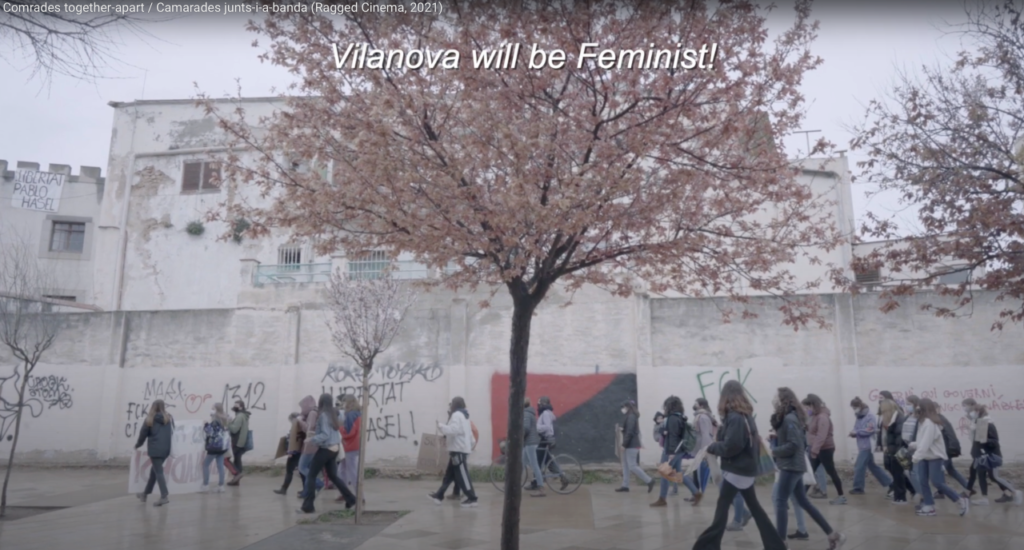
Comrades together-apart/Camarades junts-i-a-banda was made by two academics working at distance, one in Catalonia, one in Scotland. The film was shot and edited during the Covid-19 lockdown when we were forced to stay within our borders and, at times, within our own homes. The film combines footage of contemporary political protests and movements in our respective countries and reflects on actually existing colonial processes both within and outwith the higher education system. Using a poor audiovisual aesthetic, the film combines newly shot phone footage of everyday life during this moment. The film takes inspiration from the thinking of Karen Barad, in particular her notion of “cutting together-apart,” in addition to the work of other theorists, including Lucrecia Masson, Isabelle Garo, Walter Benjamin, Octavio Getino, Stefano Harney, and Fred Moten. There is a long tradition of academics and artists working at distance; however, lockdown conditions forced reflection on how academics and activists might utilize digital technology to simultaneously build theory and practice at distance. Although we had previously worked together in the dialogical form by developing written and spoken presentations, the pandemic fostered novel methods, at least for us: to think, to film, to edit, indeed, to be, together-apart online. In 2010, Remedios Zafra updated Virginia Woolf’s claim for a private space, suggesting that “a connected room of one’s own” allows for expanding creativities and alliances stemming from multiple intimate places. Conscious of its own vulnerability within profit-thirsty, private-owned networks, we pondered the extent to which this approach might help prize open the door for an internationalist invasion of nodes and the recovery of utopian thinking. We initially named our approach “Ragged Cinema,” in part after Robert Tressell’s classic socialist novel, The Ragged Trousered Philanthropists; however, as laid out below, our thinking on this title has expanded considerably and remains in-progress. In the following twelve theses, we reflect on the film’s production and Ragged Cinema’s broader concerns, ruminating on alliancial thinking and alliance building, the current state of academic filmmaking and activism, and the relationship between the dialogical and the dialectical in audio-visual form. In doing so, we hope to contribute to a conversation on how film and television scholars working within a politically committed framework, in practice and in theory, might navigate the contours of the current higher education system. The film and an earlier version of this text were presented to the 2021 Screen conference, which was hosted at the University of Glasgow, and later in that year at The Revelator Wall of Death.
Núria Araüna Baró and David Archibald. ‘Ragged Cinema: Twelve Theses on the Making of Comrades together-apart/Camarades junts-i-a-banda (Araüna Baró and Archibald, Catalonia/Scotland, 2021)’. Framework: The Journal of Cinema and Media, 63 (1&2) Spring/Fall 2022. Available at:
https://muse.jhu.edu/pub/27/article/875873